
The Philippines is a country that surprises a lot of people. You might think you know it from what you’ve heard in movies, news, or social media, but the truth is, there are plenty of things people get wrong about the Philippines. From culture to travel, the reality is often way more interesting than the myths.
Let’s clear up the confusion, bust some common myths, and give you the real scoop on life, culture, and travel in the Philippines.
Key Takeaways: What You Should Know
• Diverse Topography: The Philippines is more than beaches; it includes high-altitude mountain ranges and the BGC (Bonifacio Global City) urban tech hub.
• Linguistic Diversity: There are over 170 indigenous languages (e.g., Cebuano, Ilocano); English is a primary medium for business and education.
• Economic Reality: No longer just “Third World,” the Philippines is a rising Tiger Cub Economy with a $42 billion IT-BPM sector as of 2026.
• Climate Variations: It isn’t always hot. Baguio City hit a record low of 6.3°C (43.3°F), and highland temperatures frequently drop to 10°C.
• Labor & Productivity: Filipinos are among the world’s most industrious, with over 2.7 million OFWs supporting global healthcare and a massive 24/7 domestic BPO workforce.
• Cultural Nuance: Silence or indirectness is not weakness; it is Pakikisama (social harmony).
• Culinary Fusion: Filipino food is a sophisticated blend of Western, Spanish, and Chinese influences, with Sinigang recognized globally as a top-tier soup.
What’s Inside
- The Philippines Is Just Beaches
- Everyone Speaks Tagalog
- The Philippines Is Dangerous
- All Filipinos Want to Live Abroad
- The Philippines Is a “Third World Country”
- Filipinos Avoid Confrontation Because They’re Weak
- It’s Always Hot in the Philippines
- Filipinos Are Poor
- Filipinos Are Lazy
- Filipino Food Is Just “Exotic” or Strange
- Conclusion: The Truth About the Philippines
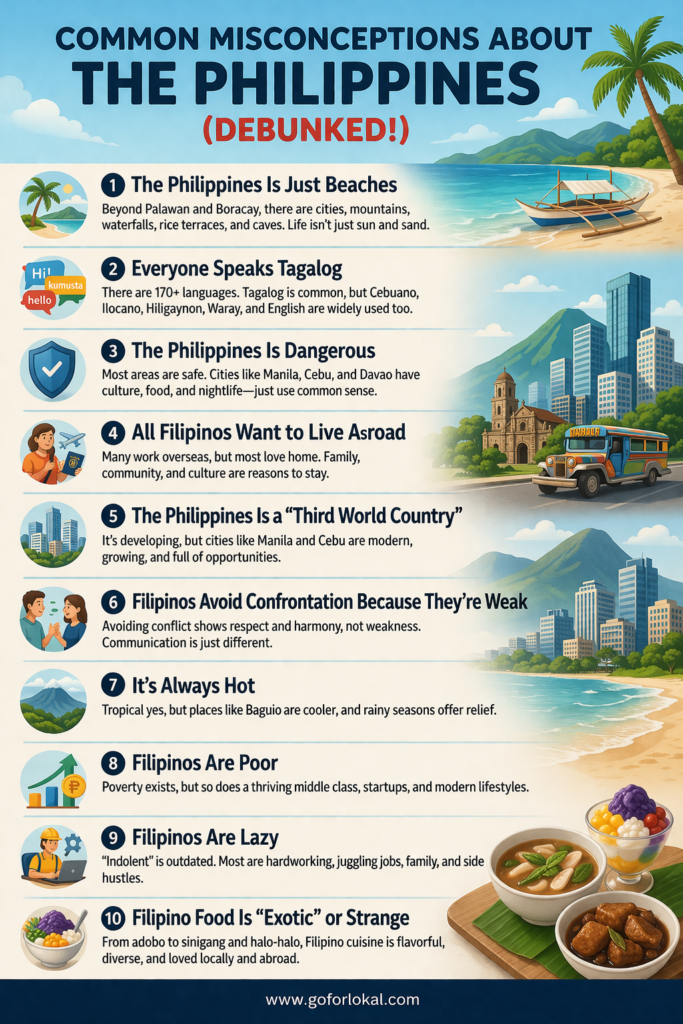
1. The Philippines Is Just Beaches
Reality: While the archipelago boasts 7,641 islands, the geography is incredibly diverse.
Beyond the coast, you’ll find the Sierra Madre mountain range, the world-famous Banaue Rice Terraces (a UNESCO World Heritage site), and the ultra-modern skyline of BGC (Bonifacio Global City). The country is as much about high-altitude trekking and “Blade Runner-esque” urban hubs as it is about surfing in Siargao.
Related: 19 Must-Visit Beaches in the Philippines for the Best Summer Vacation!
2. Everyone Speaks Tagalog
Reality: The Philippines has over 170 languages, and Tagalog is only one of them.
Tagalog is just the most widely spoken and forms the basis of the national language, Filipino. People also speak Cebuano, Ilocano, Hiligaynon, Waray… and many are bilingual or trilingual. English is also super common, so don’t worry about getting lost in translation.
3. The Philippines Is Dangerous
Reality: The Philippines is generally safe with normal travel precautions.
Some areas need extra caution, sure, but most of the country is safe for tourists and locals alike.
In cities like Manila, Cebu, and Davao, you’ll find culture, food, nightlife, and yes, traffic, but nothing life-threatening. Like anywhere else, a bit of common sense goes a long way. Outdated stories can make the country seem scarier than it really is, but the reality is much safer than many think.
4. All Filipinos Want to Live Abroad
Reality: Migration is a choice, not a universal goal.
Another one that’s often assumed is that every Filipino dreams of moving overseas. Sure, many Filipinos work or study abroad for opportunities, but the majority are happy living in the Philippines. Family, culture, food, and community matter a lot—many wouldn’t trade daily life at home for anywhere else.
5. The Philippines Is a “Third World Country”
Reality: This is an obsolete Cold War-era label. It has a developing economy with rapidly growing urban centers.
This label gets thrown around a lot, but it oversimplifies things. While the Philippines is still developing, cities like Metro Manila and Cebu are modern, fast-growing, and full of businesses, tech hubs, and opportunities.
Yes, some areas still face challenges, but that mix of progress and development is what makes the country unique. Reducing it to one label is one of the biggest common misconceptions about the Philippines.
6. Filipinos Avoid Confrontation Because They’re Weak
Reality: This is a misunderstanding of “pakikisama” or the value of social harmony. Not a weakness.
Filipino culture prioritizes social harmony and “saving face.” Silence or a smile during a disagreement isn’t a sign of submission; it’s a sophisticated social navigation tool used to maintain the dignity of both parties. It is a cultural strength rooted in empathy, not a lack of resolve.
7. It’s Always Hot in the Philippines
Reality: The Philippines has varied climates, especially in highland areas.
● Baguio City & Sagada
These northern highland areas are often referred to as the “Little Americas” of the Philippines due to their pine trees and chilly mornings.
● The Record Breaker
While many tourists pack only shorts, locals know better. In fact, Baguio City recorded a bone-chilling 6.3°C (43.3°F) in 1961. Even today, temperatures regularly drop to 9°C or 10°C during the Amihan (northeast monsoon) season from December to February.
8. Filipinos Are Poor
Reality: The Philippines has a growing middle class and expanding economy.
Movies and news often highlight poverty, but that’s only part of the picture. The Philippines also has a growing middle class, modern cities, tech startups, and thriving industries.
Assuming everyone is struggling is one of the biggest common misconceptions about the Philippines. In reality, many Filipinos are building careers, businesses, and modern lifestyles.
9. Filipinos Are Lazy
Reality: Filipinos are highly active contributors to global and domestic industries.
Statistically, Filipinos are among the most industrious global citizens, powering both the domestic economy and essential global services. The “indolence” myth—a colonial-era narrative debunked by national hero José Rizal—is completely dismantled by modern data:
● The 24/7 Global Hub
As of 2026, the Philippine IT-BPM (Business Process Outsourcing) sector is a $42 billion industry employing over 2 million full-time professionals. While many in the West sleep, this workforce manages the “Intelligence Arbitrage” for the world’s leading tech and finance firms.
● The Global Backbone
The Philippines is one of the world’s leading exporters of healthcare talent. In 2025 alone, 2.7 million Overseas Filipino Workers (OFWs) were deployed globally, helping fill critical labor gaps in countries like Japan, Taiwan, UAE, South Korea, Malaysia, and more countries.
10. Filipino Food Is Just “Exotic” or Strange
Reality: Filipino cuisine is a diverse fusion influenced by multiple cultures.
Filipino cuisine is the world’s original East-meets-West fusion. While “balut” gets the headlines, the real stars are Adobo, Sinigang (voted best vegetable soup by TasteAtlas), and Lechon. It is a flavor profile built on linamnam (umami), sourness, and saltiness that reflects centuries of Malay, Chinese, and Spanish influence.
Related: Weird But Delicious: 11 Exotic Filipino Dishes to Try for Adventurous Eaters
Conclusion: The Truth About the Philippines
The Philippines is much more than the stereotypes and stories you might hear. From vibrant cities and stunning nature to hardworking people and flavorful food, the reality is far more fascinating.
Many misconceptions come from outdated ideas or limited exposure. Understanding the real Philippines shows a country that is modern, diverse, and full of opportunities, yet deeply rooted in tradition.
Next time someone assumes they “know” the Philippines, you can set the record straight—it’s dynamic, resilient, and endlessly surprising.